Hat Bowler’s bereavement and recovery
Good Morning, Midnight (Reginald Hill Edition)Hat Bowler’s bereavement and recovery are traced through small changes in his attention and conduct rather than a single moment of healing. Two months after his girlfriend’s death in a motor accident, he returns to a place they had shared, becomes lost in the dark, and sleeps outdoors. Later, an appetite returning after weeks of feeling unwell and a conversation about birds suggest that grief has begun to loosen its hold without erasing the loss.
The wound and its return
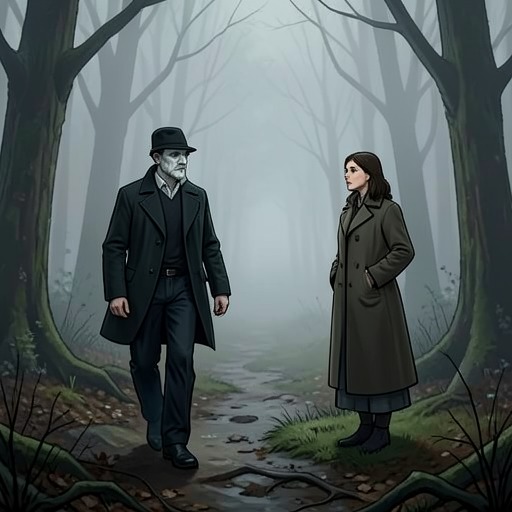
Before her death, Hat and his girlfriend had stopped at a copse in Blacklow Wood after a deer forced him to brake sharply. They pushed through a hedge, sat beneath a beech tree, drank coffee, and spoke with greater freedom and intimacy than they had before. Hat later understood that encounter as a milestone in a journey that proved far too short: the remembered place holds both the promise of closeness and the knowledge of its abrupt ending.
The day before the news from Laurence Waverley, Hat drove back to the same spot and sat beneath the same tree. Darkness fell and mist thickened, but he did not care. On the way back he realized that he had lost his bearings; for an indeterminate time he wandered over rough grass and boggy fields, then collapsed beneath another tree and slept. The excursion repeats the physical geography of the earlier intimacy while changing its meaning. Where the first visit had opened into conversation, the return leaves him alone, indifferent to night and direction.
Grief in the presence of another loss
At dawn, Hat wakes beneath branches after the fog has cleared and the night has passed, initially imagining that he is still asleep and dreaming. He is still emerging from introspection when he hears Waverley tell Lavinia Maciver that her nephew, Pal Maciver, has died by suicide at Moscow House. Hat is present for Lavinia’s silence and her question about whether anyone will need her; Waverley urges her to come with him and find out. The news does not resolve Hat’s own bereavement, but it places his private withdrawal beside another person’s sudden shock. His presence in the kitchen is obtrusive to him, even as he witnesses Lavinia being drawn into the immediate demands of loss.
His colleagues register the practical as well as emotional consequence of his grief. Shirley Novello resents that her recreational time has been consumed by extra work because an injured colleague’s girlfriend died in a motor accident two months earlier. Her irritation is directed at the disruption and at what she sees as excessive sensitivity, not at a detailed account of Hat’s suffering. The remark establishes the recentness of the death and shows that his recovery takes place within a workplace where other people encounter its effects unevenly.
Appetite and the return to ordinary life
Later, Hat wakes feeling better than he has for many weeks. His dream has shifted from dark forests to budding fruit trees with nesting birds, and hunger sends him searching his fridge. Finding nothing tempting, he soon finds himself driving toward Blacklow Cottage. Only within a couple of miles of his destination does he acknowledge the step he is taking toward normality: recognizing that other people have feelings, needs, and rights of their own. The hesitation matters. His impulse to visit Lavinia has begun as an almost automatic movement, but he stops to consider what his arrival might mean to her.
Hat remembers that Lavinia had invited him to drop by whenever he wished, then questions whether she could have meant for him to appear the very next day. His self-correction marks a change from the earlier night, when he was indifferent to darkness and lost his way, toward a renewed awareness of another person’s boundaries. He nevertheless goes to Blacklow Cottage, where Lavinia notices that he has been unhappy, declines to pry into the details of his loss, and treats his eating as evidence that his hurt mind or body is healing. She brings a huge cob of bread from the oven and redirects the conversation toward his interest in birds. Care here is neither interrogation nor a demand that he announce himself recovered: it is food, attention, and room to speak on his own terms.
Birds as an image of living
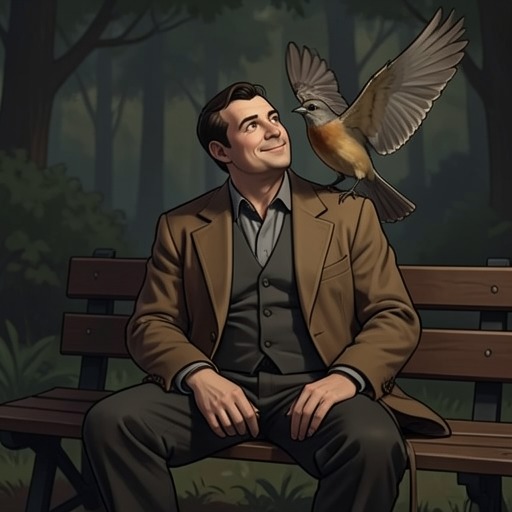
Hat traces his interest in birds to a childhood holiday on the Pembrokeshire coast. At six, sitting on the beach, he watched two cormorants fly low over rough water and tried to imagine what it felt like to move through the air above the waves. His recollection is precise about the imagined bodily experience: the ocean surging below, the spray, and the danger suggested by each breaking wave. In Lavinia’s kitchen, two blue tits, Impy and Lopside, settle on his shoulders and seem to him like an audience as she listens.
Asked whether he had succeeded in imagining the birds’ flight, Hat distinguishes the child’s attempt from what he has learned since growing up. He can now understand the sensation not only as a physical act but as an image for life itself: it is like living. The answer gives his recovery a measure without claiming that grief has ended. Earlier, he had returned to a shared place and wandered without caring where he was going; now he can turn a remembered childhood vision into speech and meet another person in conversation. The birds do not stand for a cure. They give him a language for motion, exposure, and continued life after loss.